
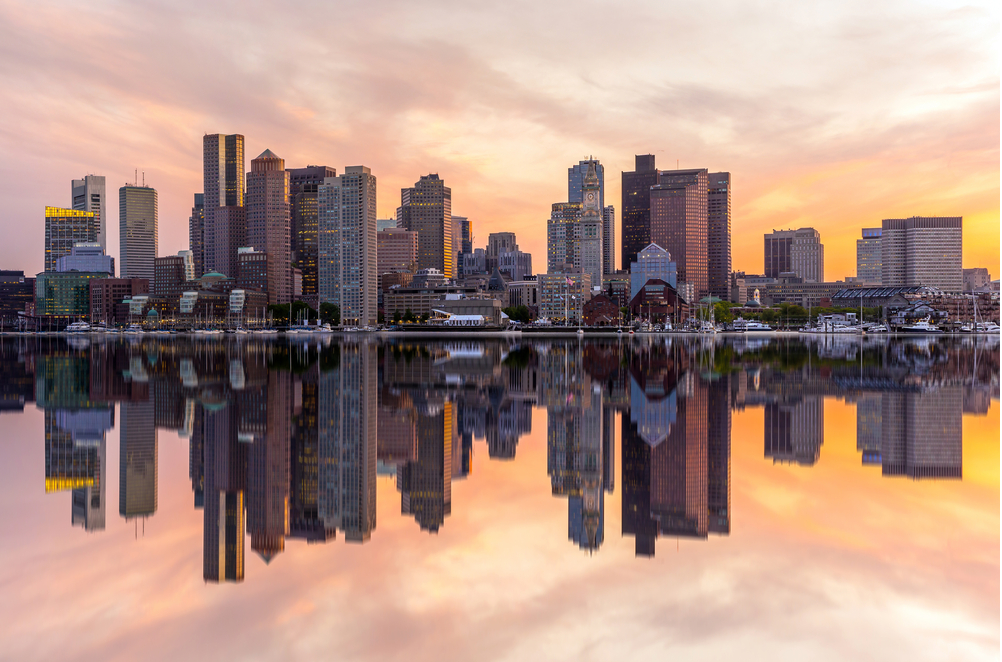
Present day view of the skyline from Boston Harbor
The amount of development taking place in Boston is impressive but Curbed Boston helped put the crazy development we see in the Seaport in perspective in their post Five Big Post WWII Changes That Shaped Modern Boston

In the late 1950s Boston’s entire West End neighborhood was razed
The most dramatic and possibly unwelcome change was the city’s wholesale demolition of the West End and the displacement of thousands of residents, all in the name of urban renewal. This alone offers insight how and why neighborhood groups became so vocal and powerful in Boston. The image on the left shows a crowded neighborhood made up of multifamily brick buildings and the image to the right shows open space which in the years that followed came to be populated by mostly ugly and uninspiring concrete structures.

Boston’s “High Spine” in the Back Bay
Other developments of note included the High Spine which started in the 1960s with the building of the Prudential in the Back Bay and continues to be developed today. Also noted was the decline of the Combat Zone (Boston’s Red Light District) sandwiched between Boston’s Theater District, Downtown Crossing and Chinatown, which is now home to some of Boston’s largest high end residences, including the posh Ritz Carlton residences. The article closes referencing both the Big Dig and the flurry of development which continues now as the city’s newest neighborhood, The Seaport, takes shape.
You can read the full article here.

 BosGuy