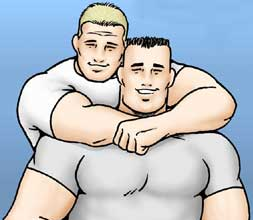
ADAM & ANDY is set in the fictional New England town of Woodfield, CT. You can learn more about Adam and Andy and purchase a copy of “the definitive collection of Adam and Andy” by visiting, adamandandy.com.
A multi-sensory winter illumination experience called, Hatched: Breaking through the Silence, launches today at the Esplanade’s Hatch Shell. The 15-minute visual and sound performance has been desiged specifically for the 80-year-old amphitheater and has been created by Boston-based artist Maria Finkelmeier.
Presentations will run daily from 5pm to 9pm starting every 20 minutes.
Each Friday morning I post a riddle to get you to think outside the box and exercise your brain. If you are stumped, share it with a friend or colleague and see if you can figure out the answer together.
I’ll confirm answers in the afternoon so don’t worry if you don’t see your comment posted right away. I want to give everyone a chance to guess.
This week’s brain teaser: What is so fragile that merely saying its name breaks it?
Amanda Gorman recited The Hill We Climb at the inauguration for Joe Biden and Kamala Harris on January 20, 2021. The 19 year old Harvard University sophomore is the youngest inaugural poet ever and the first to be named national youth poet laureate. Below, is a video of her recitation of the poem.
When day comes we ask ourselves, where can we find light in this never-ending shade? The loss we carry, a sea we must wade. We’ve braved the belly of the beast, we’ve learned that quiet isn’t always peace and the norms and notions of what just is, isn’t always justice. And yet the dawn is ours before we knew it, somehow we do it, somehow we’ve weathered and witnessed a nation that isn’t broken but simply unfinished.
We, the successors of a country and a time where a skinny black girl descended from slaves and raised by a single mother can dream of becoming president only to find herself reciting for one. And, yes, we are far from polished, far from pristine, but that doesn’t mean we are striving to form a union that is perfect, we are striving to forge a union with purpose, to compose a country committed to all cultures, colors, characters and conditions of man.
So we lift our gazes not to what stands between us, but what stands before us. We close the divide because we know to put our future first, we must first put our differences aside. We lay down our arms so we can reach out our arms to one another, we seek harm to none and harmony for all.
Let the globe, if nothing else, say this is true: that even as we grieved, we grew, even as we hurt, we hoped, that even as we tired, we tried, that we’ll forever be tied together victorious, not because we will never again know defeat but because we will never again sow division.
Scripture tells us to envision that everyone shall sit under their own vine and fig tree and no one should make them afraid. If we’re to live up to our own time, then victory won’t lie in the blade, but in in all of the bridges we’ve made.
That is the promise to glade, the hill we climb if only we dare it because being American is more than a pride we inherit, it’s the past we step into and how we repair it. We’ve seen a force that would shatter our nation rather than share it. That would destroy our country if it meant delaying democracy, and this effort very nearly succeeded. But while democracy can periodically be delayed, but it can never be permanently defeated.
In this truth, in this faith, we trust, for while we have our eyes on the future, history has its eyes on us, this is the era of just redemption we feared in its inception we did not feel prepared to be the heirs of such a terrifying hour but within it we found the power to author a new chapter, to offer hope and laughter to ourselves, so while once we asked how can we possibly prevail over catastrophe, now we assert how could catastrophe possibly prevail over us.
We will not march back to what was but move to what shall be, a country that is bruised but whole, benevolent but bold, fierce and free, we will not be turned around or interrupted by intimidation because we know our inaction and inertia will be the inheritance of the next generation, our blunders become their burden. But one thing is certain: if we merge mercy with might and might with right, then love becomes our legacy and change our children’s birthright.
So let us leave behind a country better than the one we were left, with every breath from my bronze, pounded chest, we will raise this wounded world into a wondrous one, we will rise from the golden hills of the West, we will rise from the windswept Northeast where our forefathers first realized revolution, we will rise from the lake-rimmed cities of the Midwestern states, we will rise from the sunbaked South, we will rebuild, reconcile, and recover in every known nook of our nation in every corner called our country our people diverse and beautiful will emerge battered and beautiful, when the day comes we step out of the shade aflame and unafraid, the new dawn blooms as we free it, for there is always light if only we’re brave enough to see it, if only we’re brave enough to be it.
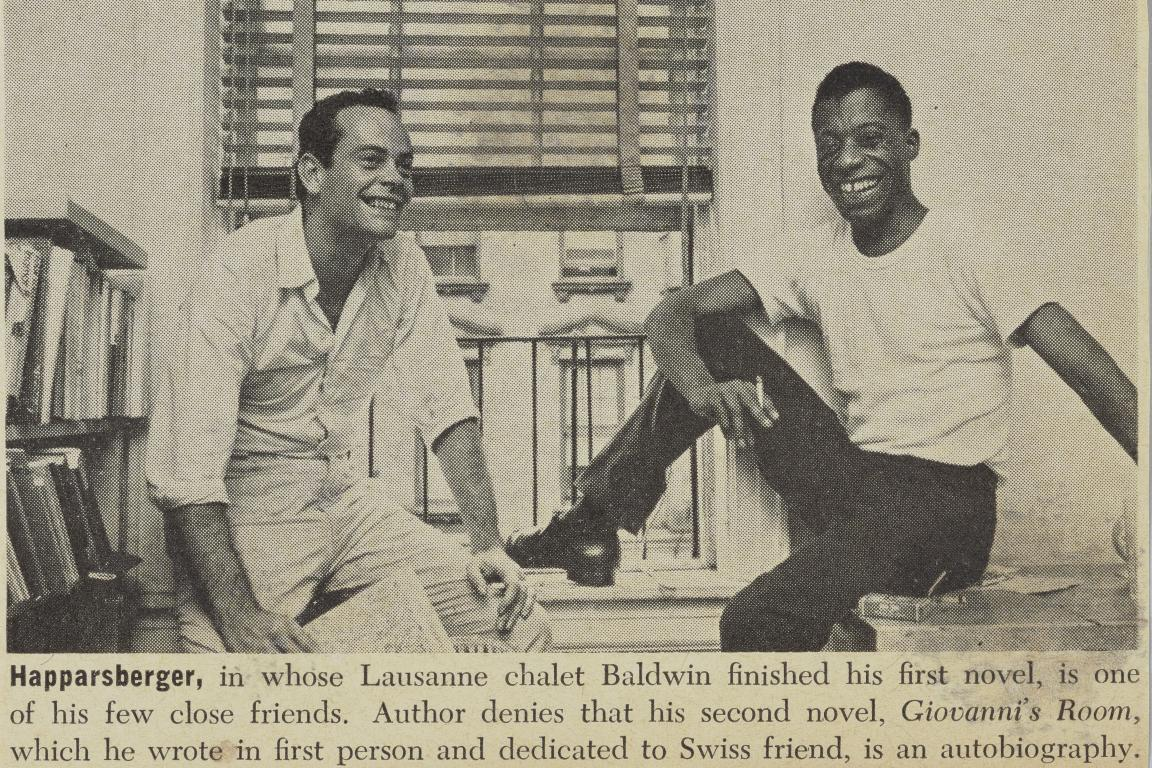
James Baldwin was romantically linked to the bisexual Swiss painter, Lucien Happersberger. They met in Paris in 1949 when Lucien was 17 and remained lifelong partners, but as you can read from the newspaper clipping shared above, the public would only know them as “close friends”.
In addition to his book Giovanni’s Room, which I highly recommend. Baldwin was highly quotable. Below is a personal favorite quote of mine.
I love America more than any other country in the world and, exactly for that reason, I insist on the right to criticize her perpetually.
James Baldwin, American author, poet and activist
I dedicate this weekly post, featuring vintage gay photographs, to the men and women who lived in a more critical time where being true to yourself and loving who you want wasn’t always an option and came at a great price. Do you have a photo you would like to share? Email me at bosguymail@gmail.com.
The Zakar twins are equal parts cute and funny. They are proud of their Iraqi heritage but grew up in the United States. In 2017, they self-published their book Pray the Gay Away, in which they tell their personal story of first coming out to themselves then later to each other and then ultimately to their Mom who had more than a little difficulty coming to terms with the news.
The Instagram account is filled with pictures of the twins (often shirtless). The twins have a great sense of humor and use their Instagram to show it off which is refreshing to see as you may be able to tell from the photos I’m sharing from their Instagram account.
Hopefully the caption I’ve shared below inspires you to offer up one or two of your own. Leave a funny caption as a comment for this post, and I’ll approve it for readers to enjoy.
The Boston Gay Men’s Book Club chose Eric Cervini’s 2020 book, The Deviant’s War: The Homosexual vs. The United States of America for this month’s read. It was my first time joining a book club, and I really enjoyed listening to people share their thoughts. The organizers surprised everyone by having the author (shown below) join the MeetUp to answer questions about the book which was really kind of amazing.
The Boston Gay Men’s Book Club meets virtually due to COVID-19 and as a result is really open to anyone interested in joining a book club that focuses on gay literature. You can learn more or sign up to join here.
This is a book about the beginnings of the gay movement here in the United States, but focuses on Franklin Edward Kameny, a World War II veteran and gifted astronomer turned reluctant, gay activist and litigator after he was entrapped by the S.F.P.D. in 1957 and charged with “lewd conduct”. The charge would result in Kameny losing his certification to work for the Department of Defense just as his promising career was starting. He would be barred from employment with the Federal Government and agencies that served our government just as the Cold War’s space race between the U.S. and U.S.S.R. started.
After World War II, Homosexual arrests…occurred at the rate of one every ten minutes, each hour, each day for fifteen years. In sum one million citizens found themselves persecuted by the American state for sexual deviation.
Simply put, Cervini’s book is a page turner. We learn early on that Kameny is a gifted intellectual. He learned to read by age four. By age six he decided he would be an astronomer and at the age of 16 enrolled in college. He would serve in the military during WWII and went to Harvard after the war in 1948 to begin his PhD in astronomy. However, the career he cherished and had so much to offer would be denied to him, because our government would label him a deviant.
The personal struggles and obstacles Kameny faced were not unique. What was unique, was Kameny’s conclusion that homosexuality is “moral in a real and positive sense, and are good, right, and desireable, socially and personally”. This view was at odd with the U.S. government, the medical community and the public at-large which perceived homosexuality as a dangerous deviance. When Kameny approached the American Civil Liberties Union (ACLU) in 1958 to ask for help he received the following response, “It was not within the province of the Union [ACLU] to evaluate the social validity of laws aimed at suppression or elimination of homosexuals.”, meaning if you were a homosexual the ACLU would not work with you or help you because you were considered a deviant.
In telling the story of Kameny’s extraordinary life, Cervini shares how self-respect and pride in one’s self emerged to become the cornerstone of the modern LGBTQ movement.
Facing this reality, Kameny used his intellect and tenacity to fight back in the courts. For years his efforts would be in vain, but homosexuals facing similar treatment sought him out. He would go on to found the Mattachine Society of Washington D.C., organize and participate in the first public demonstrations for gay rights, be among the first to ask politicians to support gay rights, run for Washington D.C.’s first congressional seat, and form an ongoing legal defense for victims through the 1960s and 1970s.
Aside from being a fascinating read, the book helped provide me with some much needed perspective on how much society has changed and helped me understand where and how the modern LGBTQ movement started. It begins more than a decade before the Stonewall Riots, introducing the controversial (and unethical) work done by sociologist Laud Humprhies as well as what Kameny and several others did in the 1950s and 1960s to help pave the way for the LGBTQ community to organize, self-actualize and speak up. This book introduced me to compatriots and contemporaries of Kameny who I had not heard of before. I hope because of the attention given to these activists, more will be revealed about their lives and contributions in future publications. I would love to see this included in U.S. History curriculum and as part of school reading lists.
Though Kameny did not have a term for it yet, by exposing the arbitrary logic of the purges with his own, contrary logic, he formulated gay pride as a political tool of resistance, a weapon to be wielded for now [1961], only in the courts.”
If you’re interested in purchasing this book and open to supporting local bookstores, try one of the links I’ve shared. They will take you right to the book so you can order it online in just a couple of clicks. Alternatively, you can check your local library for a copy of this book. Here is a link to the BPL for The Deviant’s War.
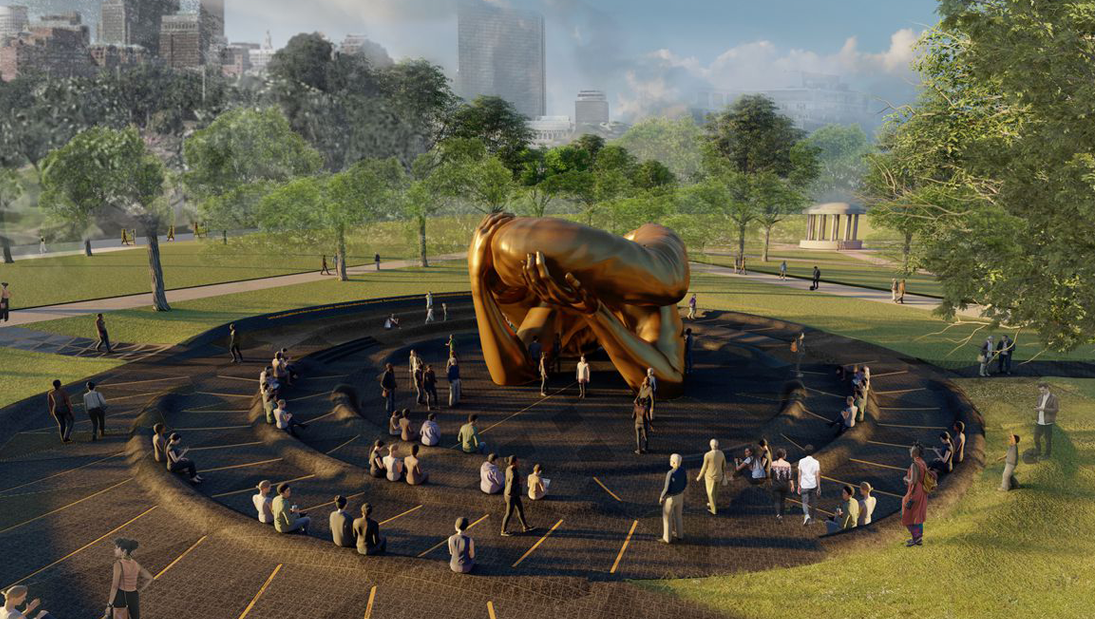
King Boston, the privately funded non-profit working to create a living memorial and programs honoring the legacy of Dr. Martin Luther King Jr. and Coretta Scott King shared this rendering of the large sculpture that will be added to the Boston Common next year near the start of Boston’s Freedom Trail.
The memorial is intended to inspire people to reflect on the values of racial and economic justice that the couple espoused in word and action. Through the memorial and related programming, King Boston envisions a more inclusive and equitable Boston. Martin Luther King Jr. met his wife Coretta Scott King in Boston in 1952 when he was studying at Boston University and she was attending New England Conservatory of Music.
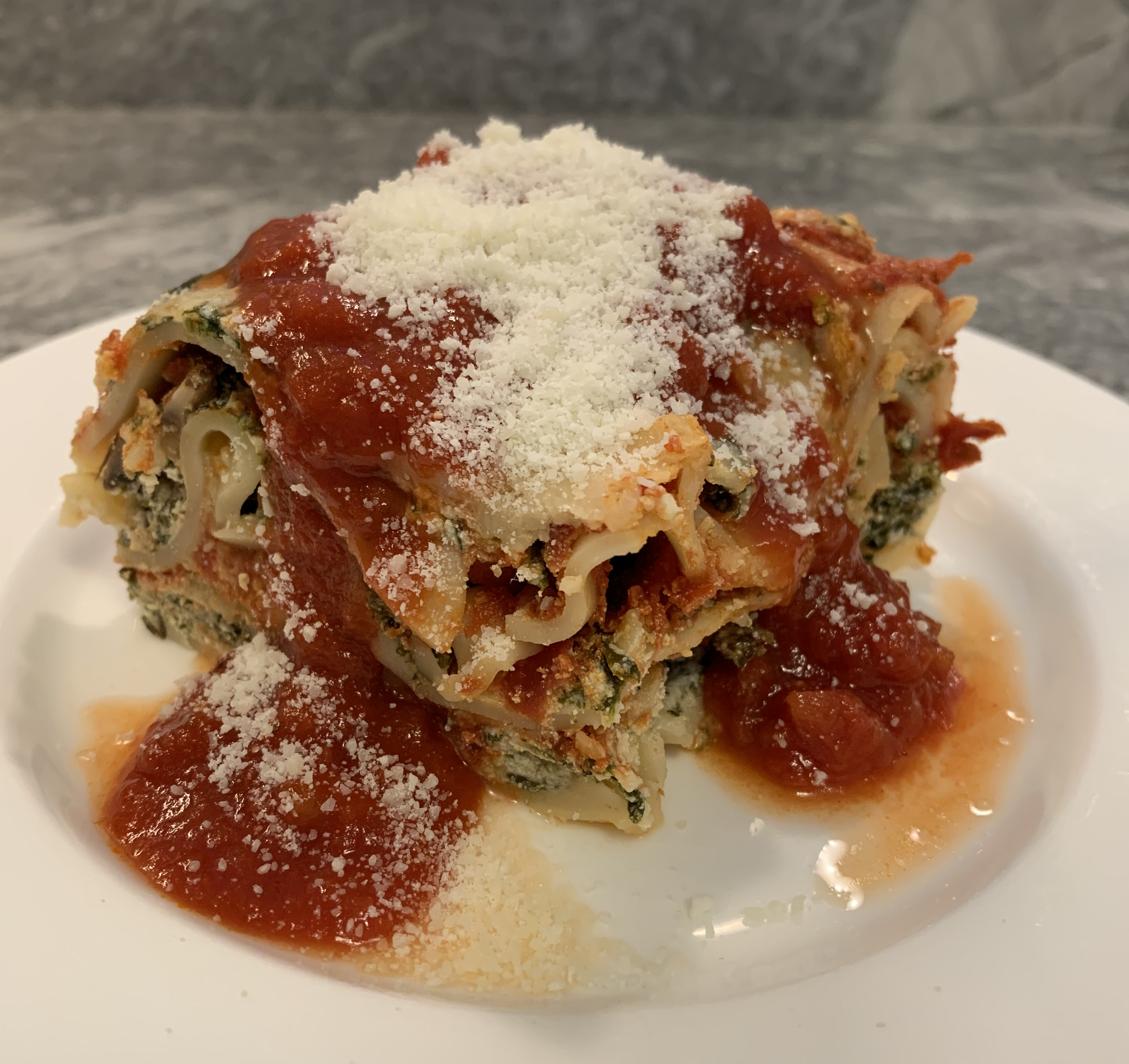
Keeping with the theme of good Italian-American comfort food recipes that are great to make in the winter, this week I’m sharing a modified recipe I found on the web and made my own. I prefer to make this without meat because it is a little lighter, and I use a shortcut that would make adding meat more tedious.
There are three phases to this recipe. The first phase requires the food prep (chopping your veggies). The second phase requires making the filling and boiling the pasta (ever so briefly). And finally, the third phase involves assembly and baking. The ingredients you will need for this recipe include:
1 box of lasagna pasta 1 1/2 jar of good marinara sauce 8 oz of mushrooms (I use baby bella) 1 sweet onion 3-4 garlic cloves 2 bags of prewashed baby spinach 16 oz of Ricotta cheese 4 oz of shredded mozzarella cheese 4 oz of grated Parmesan cheese
1 egg Salt Pepper Italian parsley Italian seasoning Oregano
Phase 1: The Prep
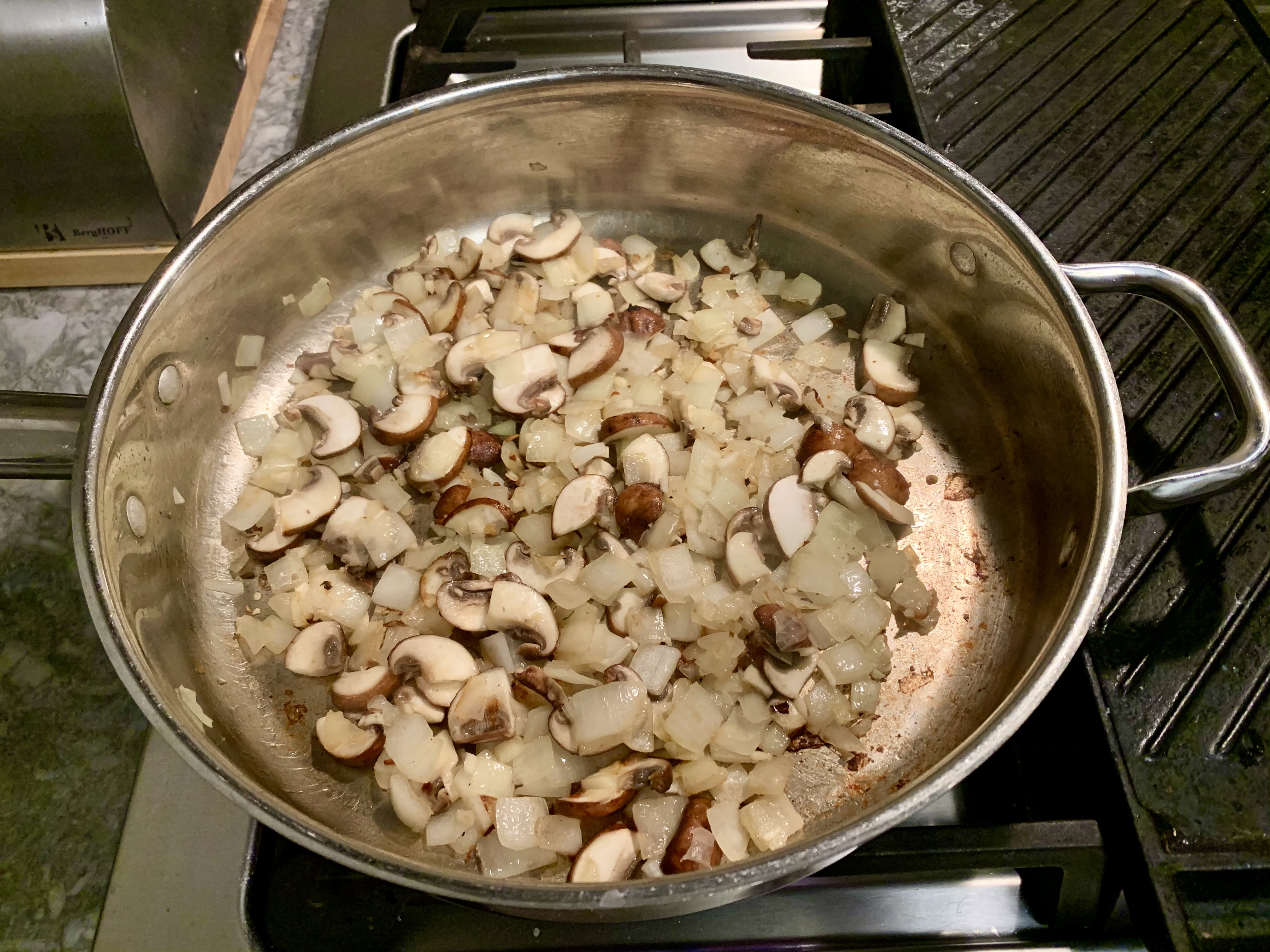
Preheat your oven to 350 degrees, lightly oil your baking pan and start to boil your water in a large pot for the lasagna. Roughly chop the mushrooms and parsley and mince the garlic and onion then set aside.
Phase 2: Making The Filling
Add olive oil to a pan on medium high heat and sauté the onions. As they start to soften turn the heat down to medium and add the garlic and mushrooms. After they cook, remove and place in the refrigerator to cool. In the same pan, add a drop or two of olive oil, your spinach and a pinch or two of salt. Stir to prevent from sticking to the pan – this should wilt in 1-2 minutes – and take out to cool.
In a large mixing bowl, add the Ricotta cheese, half your grated Parmesean cheese, egg, sautéed veggies and spinach. The vegetables don’t need to be cold but you don’t want them to melt the cheese. Blend or mix these ingredients so they evenly combine. Then add a cup of roughly chopped parsley and a healthy amount of black pepper and dried seasonings (don’t be shy with this) and stir until combined then set aside for assembly.
Once the water is boiling and you’ve finished your mixture (see above) add your lasagna. My mother doesn’t bother with this step, but I boil the lasagna for about 5 minutes so it is easier to manage. If you don’t briefly cook the pasta it is more difficult to manipulate and trim to fit into your baking dish.
Phase 3: The Assembly & Bake
Drizzle a little oliver oil on the bottom of your baking pan and use a paper towel to spread evenly along the bottom and sides. Then place one layer of lasagna so it completely covers the bottom of the baking pan. This is where having a pliable pasta you can trim makes assembly so much easier.
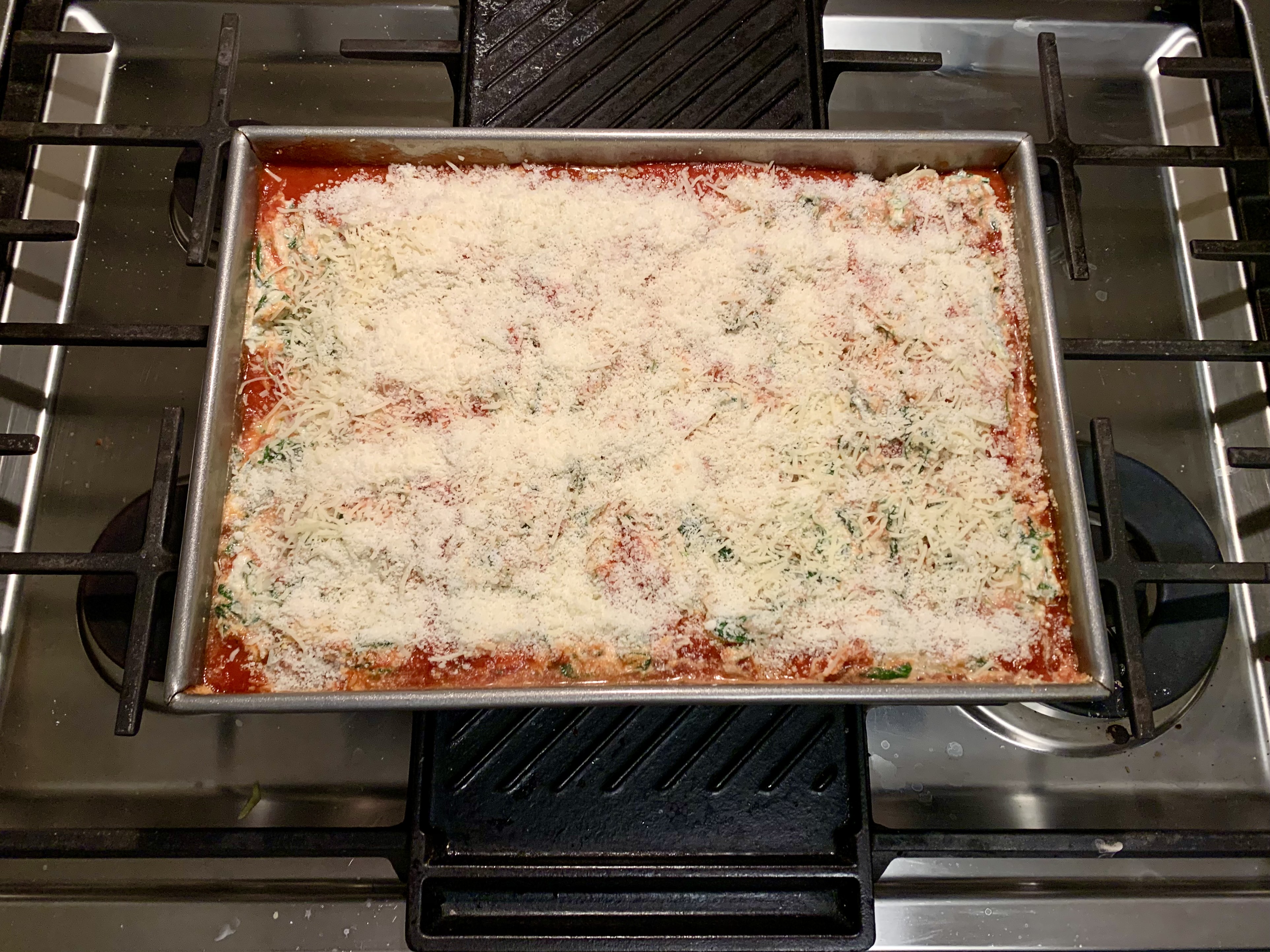
Then take approximately 1/3 of the cheese fillling and spread it on top of the lasagna noodles. I use a good jarred marinara sauce and pour it over the cheese mixture, using my spatula to spread so it completely covers the cheese filling. Then add a thin layer of shredded mozzarella. Repeat this process two more times so you have three layers of pasta, cheese sauce, red sauce and mozzarella. Finally, sprinkle the Parmesan cheese over the top of the lasagna.
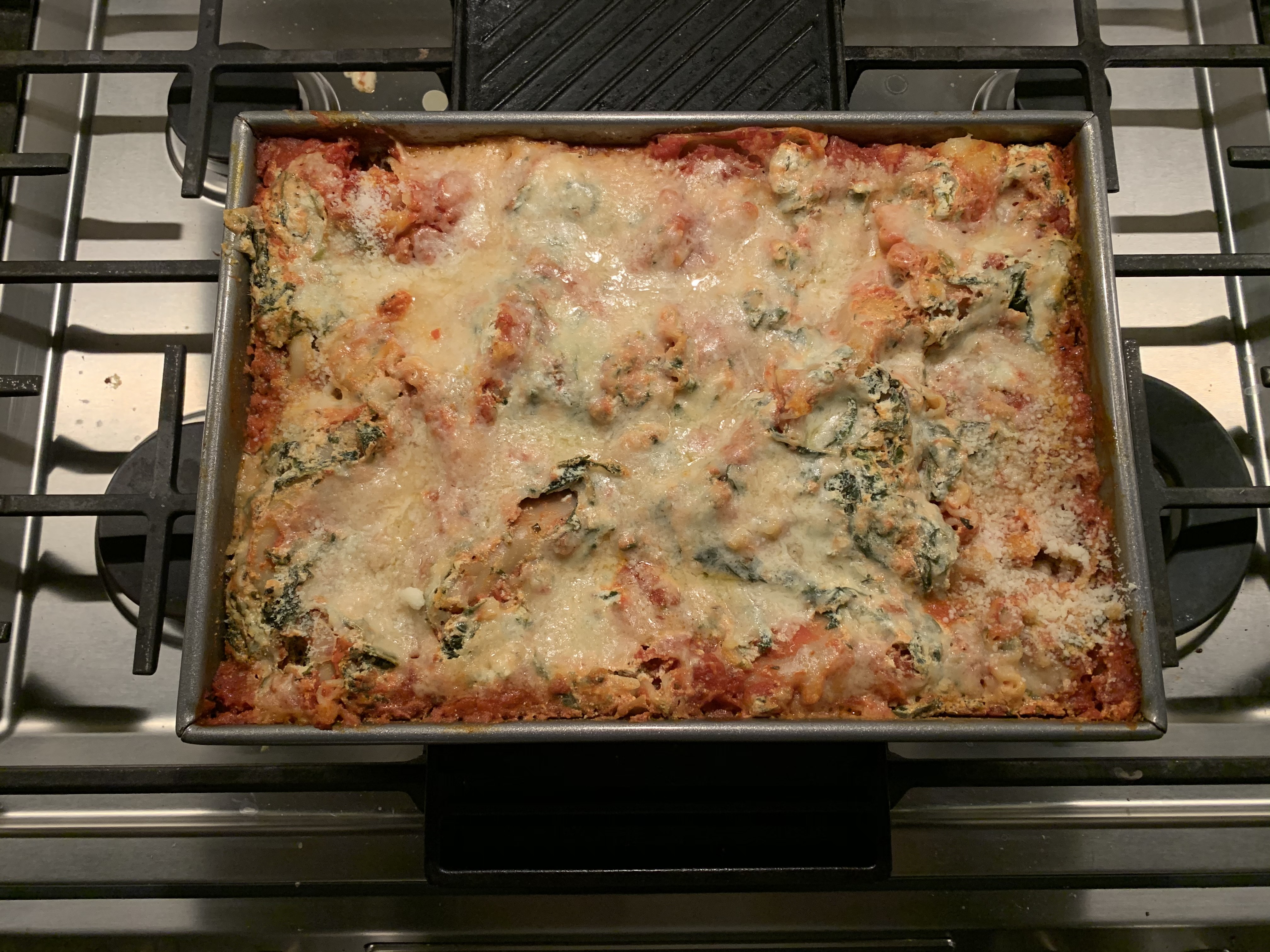
Cover the baking pan with foil to your preheated oven and bake for 1 hour. If you want extra red sauce with your lasagna, now is the time to make a quick sauce to serve on the side. I use the same jarred sauce and heat it up with some diced onions and parsley.
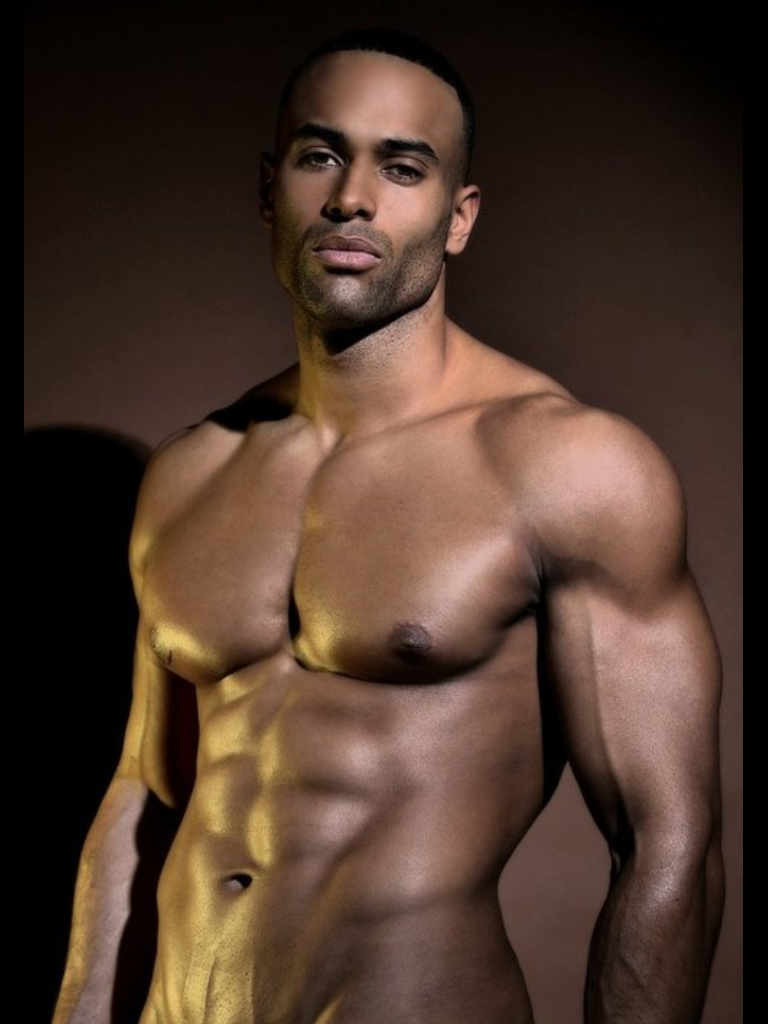
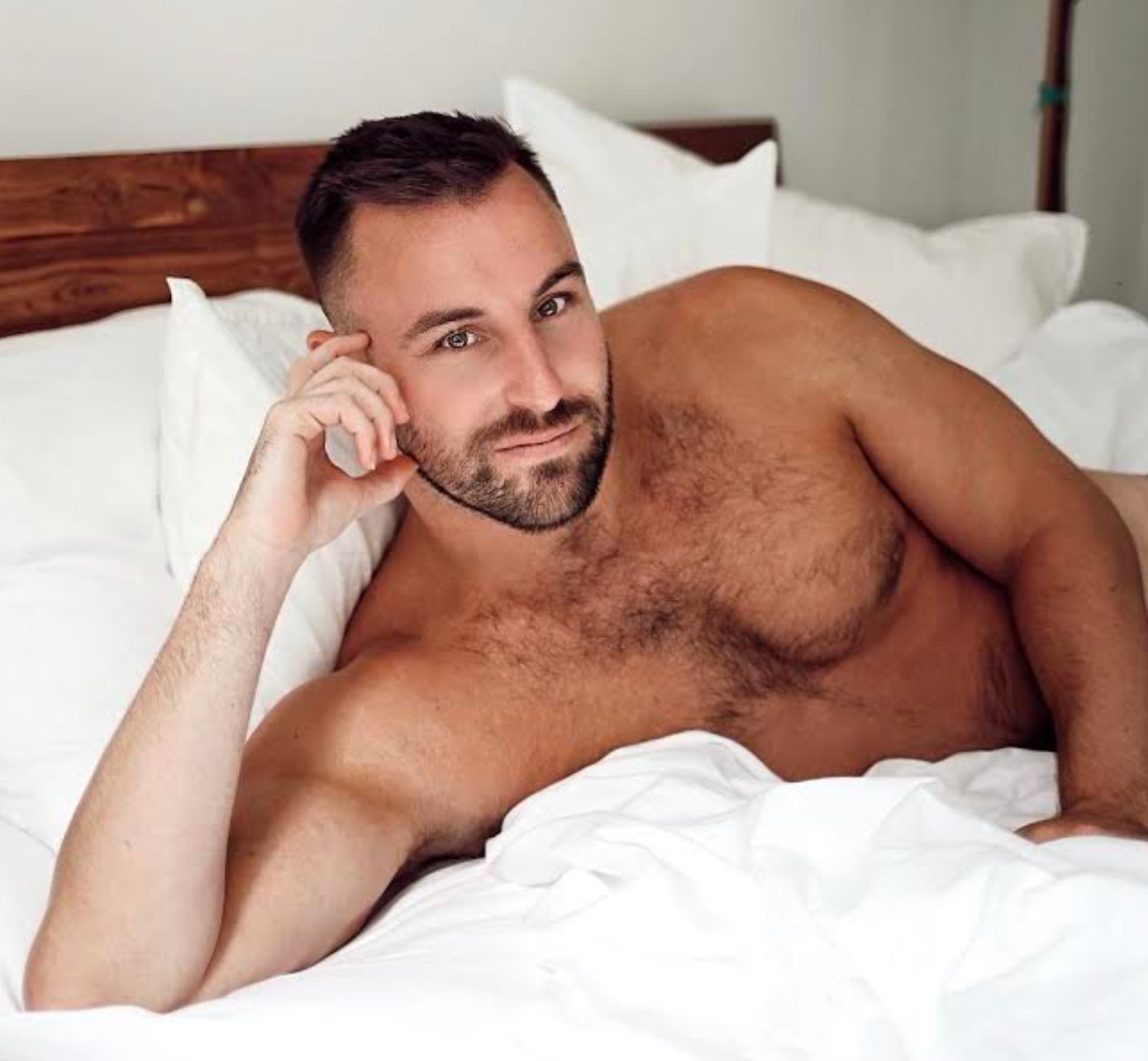
Brian Morr is a menswear and lifestyle blogger who calls Manhattan home. You can check out his blog, Sink the Sun. I liked this photo which he posted this past fall and thought it made for a great Scruffy Sunday post.